
Rapidly Growing Retail Market with Huge Potential
-
 Karolina Mikoliūnaitė
- 5 min read
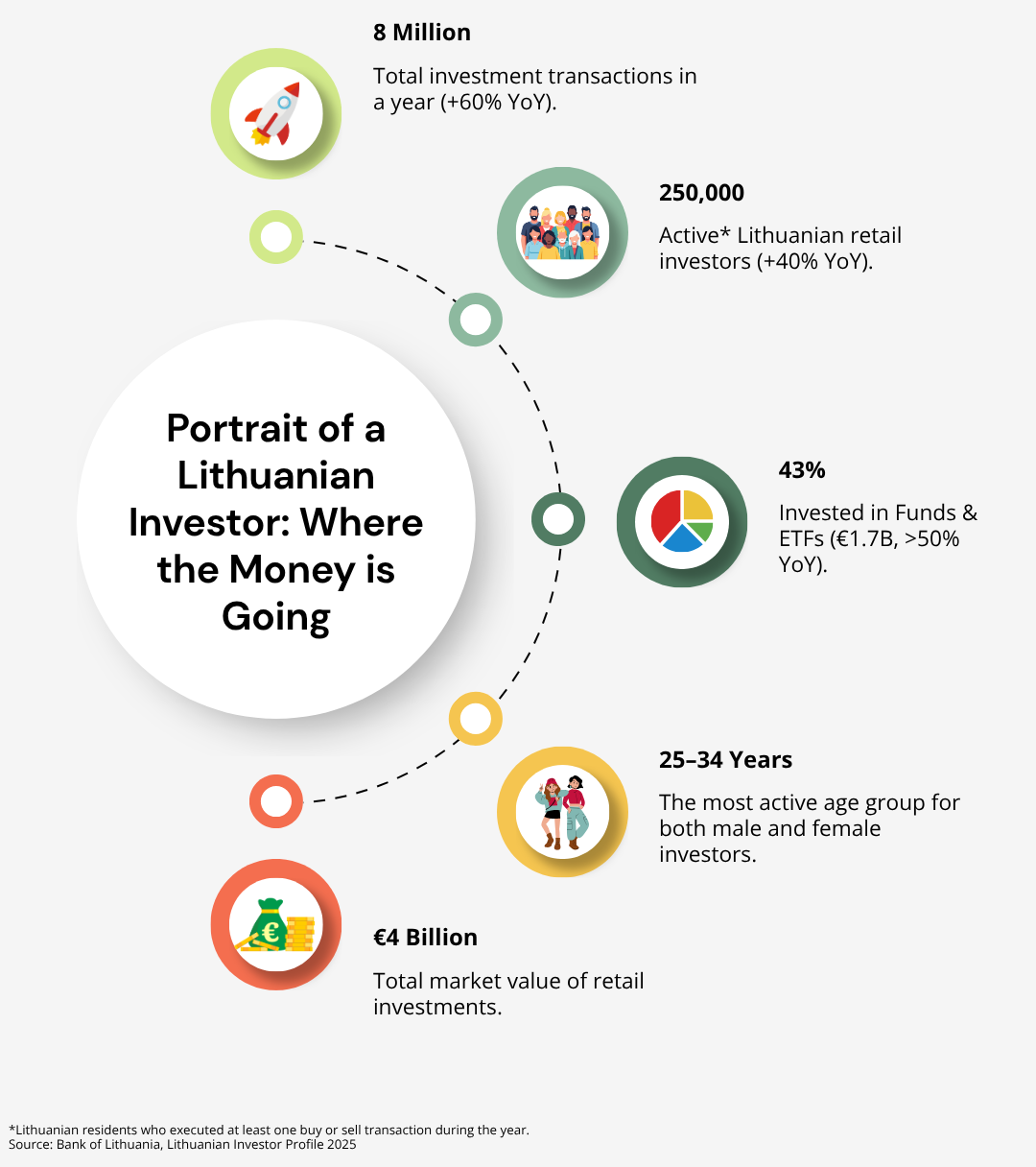
Only around 250,000 people – or about 9% of Lithuania’s population – invested in financial markets in 2025, according to Bank of Lithuania data. While this may seem like a relatively small share, the number of investors grew by 40% year-on-year. It shows that there are a lot of potential retail investors coming into the market and room for investment brokers to expand, though there are still key factors to keep in mind.
Growing up in Panevėžys, Lithuania's fifth-largest city, any money my parents gave me or that I received as a gift went straight into a piggy bank. Back then, I didn’t know what else to do with it except let it accumulate until I decided to spend it on something I wanted, like a toy or nice clothes. At the time, I had no idea what investing was.
My family didn’t have investments in financial markets either. All we had were bank deposits. Well, better than nothing, but is that investing? In my view, it’s smart saving. Oh, and we also had a house – but is a house where you live, pay taxes on, and maintain really an investment? To me, it seems hard to count financial profit when you're constantly spending money on its upkeep. Though, at least property values tend to increase over the years.
In Love with Bricks
That naturally leads us to real estate. Historically, Lithuanians love property, and that is where they invest the most. Why not capital markets? There are many reasons. First of all, we didn’t have that tradition. Our local stock market lacked liquidity, and people suffered bad investment experiences in the past – for instance, during the privatization era at the dawn of independence, or from shaken confidence following bank failures. As a result, large sums of money are still kept in cash or sitting in everyday bank accounts paying little to no interest.
Real estate, on the other hand, is visible, well-understood, and physically tangible. There's even a joke that property is in a Lithuanian's blood – something a "real" Lithuanian will definitely own.
One or two-bedroom flats in big cities are the most common choice. They are either older properties inherited from relatives or newer apartments bought with savings. Some people rent out not just one, but two, three, or more units.
Unfortunately, not everyone does their homework, keeps records, or correctly calculates the actual financial annual return. Typically, it generates around 3-6%. Compared to the historical stock market average of ~10%, it is way less, but it’s hard to argue with people who follow the majority and are passionate about "bricks."
Don't get me wrong: there is nothing bad about investing in real estate. My goal here is simply to draw attention to people's lack of portfolio diversification and financial literacy.
Flipping the Script
I remember having a few economics and finance classes in high school, but no matter how hard I try to recall what the teacher taught, not much pops into my head. It just flashes by like a blur.
For a long time, financial literacy in the Lithuanian education system remained on the margins. The subject didn't get enough attention – neither at school nor at home. And it’s sad, because it requires effort from multiple sides. It is an essential life skill, not something you are born knowing, that should be developed continuously. Importantly, first steps need encouragement from the outside.
Fortunately, changes are happening. While financial literacy lessons are still not mandatory in every Lithuanian school, there are now free and paid initiatives for both kids and adults offered by non-governmental organizations, financial companies, investors' clubs, and individuals. They understand that financial literacy is not only one of the most vital skills affecting a person's quality of life, but it also benefits the country as a whole to have financially successful citizens contributing to economic growth. It’s a win-win situation.
It makes me happy when I meet high school pupils and students who are passionate about growing their wealth. They are curious about different asset classes, explore strategies, and are often much braver. Being young, they shouldn't be afraid to take on greater risk – they have plenty of time on their side if things don't go as planned. Plus, learning and making mistakes is fine when the amounts involved are small.
Much of their knowledge comes from social media, friends, or family conversations, as children are increasingly included in talks about money. Again, it’s a win-win situation – nowadays, kids often know more about modern investing than their parents, making dinner table discussions surprisingly interesting.
Market Shifts
Overall, Lithuanian residents have only in recent years begun discovering financial markets on a larger scale. Statistics show growth not just in the number of retail investors, but in transaction volumes, portfolio values, and – most importantly – general interest. Media coverage has also increased, helping make investing more visible and accessible while building awareness through educational content, news, and unembellished stories from real investors.
The investment landscape in Lithuania has undergone significant shifts in recent years. New brokers and instruments have emerged, lowering entry barriers, offering wider choices, and reducing fees.
The long-awaited investment account finally launched, designed to simplify investing and offer tax deferral. Sure, not everything works seamlessly yet – the declaration system in its first year was overly complex, reporting requirements were tricky, and investors still have unanswered questions. In fact, only around 26,000 people declared one in this first round. That means the vast majority still uses the traditional tax system. But establishing this new account shows a genuine effort from the government to modernize retail investing. All the active feedback from investors simply proves that the demand is real and people want a better system. I'm optimistic that things will smooth out over time.
In fact, I suspect there are far more retail investors in Lithuania than a quarter of a million. Bank of Lithuania statistics don't capture every international broker account used by residents, such as Interactive Brokers. The real numbers are likely higher, and current trends show plenty of room to grow.
In fact, I suspect there are far more retail investors in Lithuania than a quarter of a million. Bank of Lithuania statistics only track activity reported by locally licensed banks, brokerages, and management companies. They don't capture residents investing directly through major foreign platforms or cross-border brokers, such as Interactive Brokers or Trading 212. The real numbers are likely higher, and current trends show plenty of room to grow.
The Outlook Is Positive
Systemic changes require time and patience, but the effort and initiatives are well worth it. It’s exciting to see younger generations equipped with better tools, resources, and access to shape their financial mindsets compared to previous generations. The transformation is promising, and the future looks bright.
And no, you don't need to abandon real estate. Different asset classes can fit comfortably within a single investment portfolio – the key is to prioritize diversification and remain open to learning.
Taking initiative with your own money is essential. After all, why shouldn't you? It’s your wealth, and you have skin in the game. So, what are you waiting for? Go pick up a great finance book, tune into an engaging podcast, or learn from experienced investors and put that knowledge into practice.